
Last updated:
September 6, 2024 11:53 EDT

If it continues to shed over the weekend, $ETH could begin next week consolidating a new support level of around $2,000.
Crypto’s second biggest currency, the $285 billion market cap $ETH token underpinning Ethereum, the blockchain with the most commercial activity, has crashed to a one month low overnight.
On paper, Ethereum’s 24-hour loss of 1% is in step with the trillion-cap market leader Bitcoin ($BTC) which shed the same amount.
Bitcoin currently changes hands at $56,172, while Ethereum is about $2,369. Both leading cryptocurrencies shed roughly 6% over the last seven days.
The last time Ethereum traded this low was on August 7 last month, when it’s price bottomed out at $2,351 after a heavy market crash two days prior.
The last time Ethereum traded consistently in the $2,300s was in early February this year.
Ethereum has been struggling a little this year. The launch of spot Bitcoin ETFs in January helped pull up the price of all cryptocurrencies considerably, including Ethereum.
Spot Ether ETFs came next, back in mid-Summer, but cooling inflows have helped dampen investors’ sentiment.
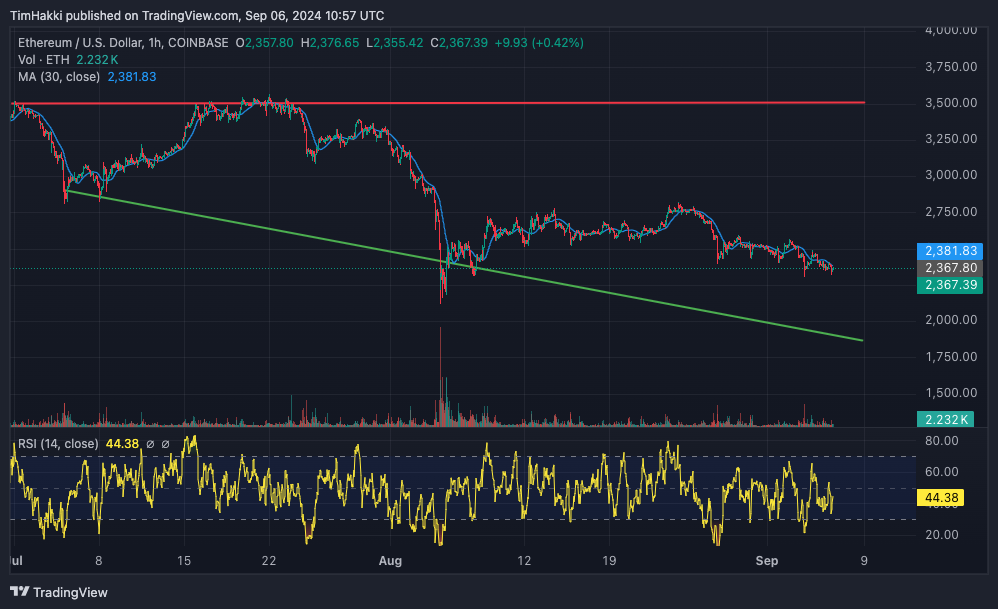
Ethereum is currently trading far short of its $3,500 resistance level, seen throughout the summer.
If it continues to shed over the weekend, $ETH could begin next week consolidating a new support level of around $2,000.
 Source: TradingView
However, there are two indications that holders may not incur further losses.
The first is that Ethereum’s price has risen in the last hour closer to its thirty-day moving average of $2,382.
The coin’s rising relative strength index (RSI) of 44 suggests investors are doing a spot of dip-buying.
Disclaimer: The content of this article solely reflects the author's opinion and does not represent the platform in any capacity. This article is not intended to serve as a reference for making investment decisions.
Can the Bank of Japan's "twist operation" really suppress long-term interest rates? Goldman Sachs: Fiscal issues are the real root cause, and term premium may persist for a long time.
Goldman Sachs pointed out that the factors driving the recent rise in long-term U.S. yields include the U.S. fiscal deficit, inflation uncertainty, large-scale AI-related debt issuance, and market concerns about an increase in the equilibrium real interest rate. Meanwhile, Treasury repo operations and adjustments in issuance structure do not affect these factors. Therefore, Goldman Sachs believes that this intervention can only temporarily relieve pressure and cannot change the trend direction of long-term yields.
Winklevoss twins donate $1.2M in ZEC to back independent Zcash development
Figure takes operational role at Provenance Blockchain Foundation under community-led structure
Beldex secures $8 million to accelerate privacy layer for Web3 and AI


