Institutions: Gold price expected to reach $4,750 in Q4 and $5,250 in Q3 next year, copper price to enjoy long-term cyclical benefits simultaneously
Huitong Finance, September 21—— Société Générale's latest portfolio rebalancing strategy indicates that in the fourth quarter, it continues to overweight equities and commodities while reducing holdings in government bonds, and remains firmly bullish on gold and copper prices. Supported by geopolitical divergence, concerns about US dollar credibility, and continued central bank gold purchases, gold has ample room for further gains, with some institutions setting a target as high as $5,250/oz. In addition, AI construction is boosting copper demand amid long-term supply shortages, and copper prices are expected to rise steadily. Moreover, US debt servicing risks are becoming prominent, further weakening the allocation value of government bonds and benefiting commodity assets.
The process of raising interest rates by multiple central banks around the world is still ongoing, signaling the start of a new tightening cycle.
The research team at Société Générale points out that even with sustained monetary tightening, inflation pressure will be difficult to suppress quickly, so gold’s allocation value remains firmly supported. In its
Asset Class Rebalancing: Add to Equities and Commodities, Reduce Government Bond Positions
Société Générale states that for fourth-quarter allocations, both gold and broad commodities maintain a 10% weighting, unchanged from Q3. Equity allocations increase from 55% to 58%, while government bonds are reduced from 15% to 12%. The bank also keeps a 5% allocation each in inflation-linked bonds and corporate bonds.
Analysts at the bank stated in the report: “So far in 2026, asset performances have diverged significantly, with equities and commodities performing exceptionally well while the bond market remains under pressure. Our SGMAP portfolio, which centers on equities and commodities, has achieved solid returns in this environment. Looking forward, commodities are indispensable assets for hedging both geopolitical and climate risks.
Multiple Drivers for Gold, Upside Potential Continues to Open Up
Gold still holds an important position in multi-asset portfolios. Société Générale believes that currency devaluation trades are making a comeback.
Bank analysts stated: “Central banks are continuously purchasing gold while reducing holdings of US Treasuries. Geopolitical divergence, coupled with worries about fiscal and monetary credibility, has led to strong demand for alternative reserve assets.”
In addition to the structural support from ongoing central bank gold buying, cyclical factors are also building up. The bank forecasts that in the latter part of the cycle, real interest rates will decline, lowering the opportunity cost of holding non-interest-bearing assets like gold. A weaker US dollar and the return of ETF flows will further boost gold prices. Global gold ETF holdings have recovered to nearly 3,000 tons, reflecting a revival in investment demand.
Based on these factors,
Tight Copper Supply-Demand Balance, New Capacity a Long Way Off
Copper is also a major focus for the bank. Analysts believe that large-scale construction of artificial intelligence data centers will fuel long-term demand for copper and other key industrial metals, while supply struggles to keep up with demand growth. In H1 2026, global copper mine output is expected to decline by 1.1% year-over-year, with the possibility of the first annual output drop since 2017. A deeper problem lies in a decade of underinvestment and scarce new project pipeline. Although higher prices might incentivize mining, truly significant new capacity is unlikely to come online before 2030.
According to price forecasts,
US Treasury Risks Persist, Debt Interest Payments Now a Key Risk
The report also warns on US debt risks. The US now faces not only a basic fiscal deficit problem, but also mounting pressure from interest payments. According to Congressional Budget Office estimates, although the primary deficit is below the peaks seen in past crises, with interest expenses rising, net interest payments as a share of GDP could approach 5% by the mid-2030s, with the overall fiscal deficit remaining above 6% of GDP for the long term.
According to the bank’s rates team,
Conclusion
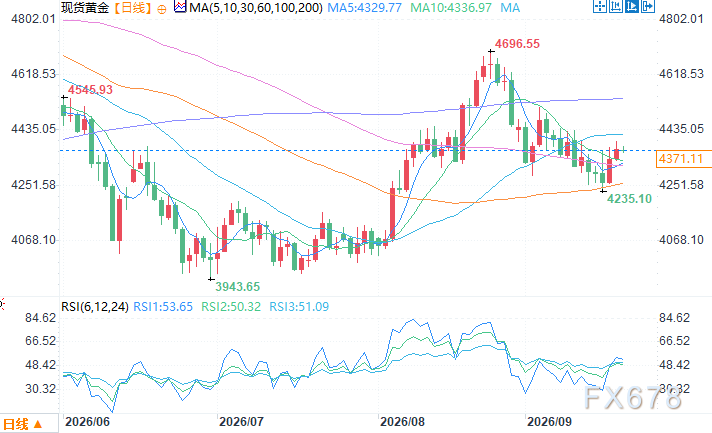
Spot gold daily chart. Source: Easy Huitong
East 8th District, September 21, 10:42. Spot gold quoted at $4,366.11/oz.





