BCA: The AI bubble hasn't burst yet, how to account for $10 trillion in one year?
Many investors believe that artificial intelligence may eventually result in a bubble.
But they also believe they can exit in time before the bubble bursts.
In its global macro research report published on August 19, BCA Research described investors’ attitude towards the current AI rally as “grant me temperance, but not yet”: everyone knows the risks are accumulating, but no one wants to leave the table too early.
The problem is, the market can’t let everyone exit at the same time. Every sale requires a buyer. When the trend truly reverses, some will inevitably be too late to leave.
Wall Street is Betting on an Almost Perfect Future
Currently, US corporate profit margins are already at historical highs, yet Wall Street analysts still expect earnings growth in the next three to five years to continue breaking records.
This means that tech companies must not only maintain high current profit margins but also create unprecedented new revenues to fulfill the growth expectations already priced into their stocks.
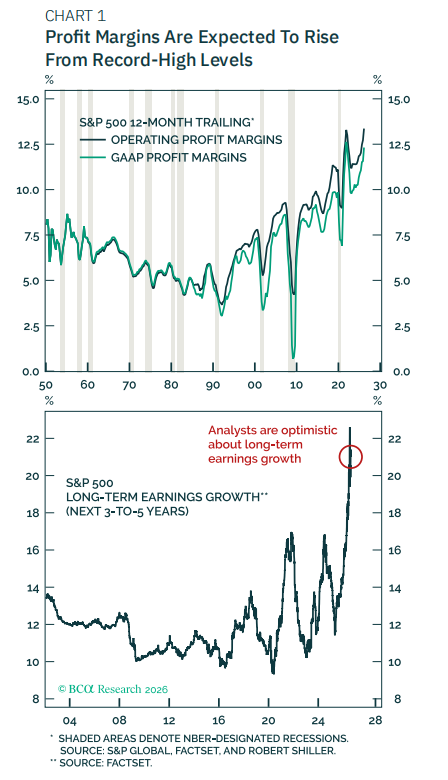
Caption: US corporate profit margins are already at historical highs, yet analysts still expect strong long-term profit growth.
Of these, the most noteworthy is the capital expenditure for AI data centers.
BCA predicts that by 2027, the annual capital expenditure of global large-scale cloud computing companies may reach $1 trillion, most of which is related to AI.
The question is: after investing so much money, how much income is needed to generate a reasonable return on these investments?
How Much Revenue Is Needed to Support One Trillion Dollars in Capital Expenditure?
BCA conducted a stress test.
Suppose large-scale cloud computing companies maintain $1 trillion in annual capex, with a combined equipment depreciation rate of 13%. In a long-term steady state:
- The original value of assets will reach approximately $7.7 trillion;
- Net assets after depreciation will be about $3.85 trillion;
- If a 30% pre-tax return on invested capital is required, about $1.15 trillion in EBIT needs to be generated annually;
- Adding back depreciation, about $2.15 trillion in EBITDA will be needed annually.
Next, the key depends on these companies' profit margins.
If future EBITDA margins can reach Wall Street's projected 50%, then about $4.3 trillion in annual revenue is required.
If margins drop to the more common 30% seen in recent years, the required revenue rises to approximately $7.2 trillion.
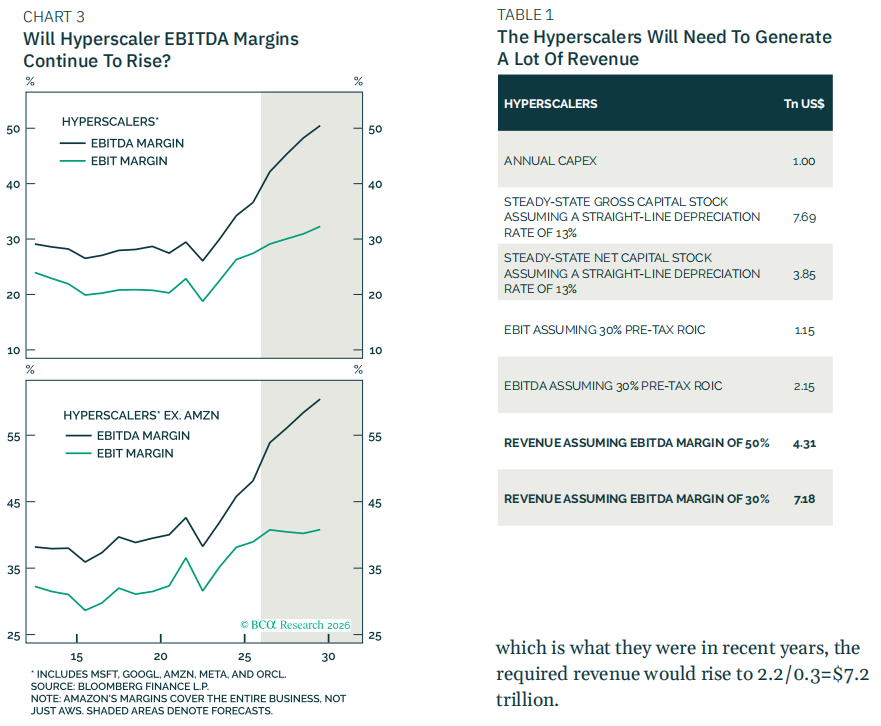
Caption: Revenue scale needed for large-scale cloud companies under different profit margin assumptions.
Moreover, this calculation doesn’t even include new types of cloud companies, Chinese AI firms, SpaceX, or other companies building infrastructure around AI.
If the entire AI ecosystem's capital expenditure is counted, BCA believes that AI may ultimately need to generate $10 trillion in annual revenue to justify this wave of investment.
What does this mean?
Global annual spending on food and dining is around $10 trillion, and global healthcare expenditures are roughly the same. In comparison, the current global software market is only about $1.4 trillion.
It’s worth emphasizing that the $10 trillion figure is not a prediction of next year’s AI revenue, but a stress test: if current capital expenditure continues over the long term, and investors demand a sufficient return from these assets, then the commercial scale of AI eventually needs to reach an extremely large magnitude.
If This Calculation Is So Difficult, Why Hasn’t the Bubble Burst?
Because current data hasn’t signaled a clear collapse yet.
Some indicators even continue to support the AI rally:
- High-performance GPU rental prices continue to rise;
- Spot and contract prices of storage chips continue to climb;
- Enterprise AI adoption rate is still increasing;
- AI-related spending has not shown a significant drop.
These phenomena indicate that computing power supply is still tight and datacenter capacity has not yet clearly exceeded demand.
Meanwhile, warning signs are also emerging:
- AI model and Token prices continue to fall;
- Large cloud companies’ free cash flow has turned negative;
- Investment-grade bond credit spreads in the tech sector are widening compared to other industries;
- AI infrastructure is increasingly reliant on external financing, rather than just internal cash flow.
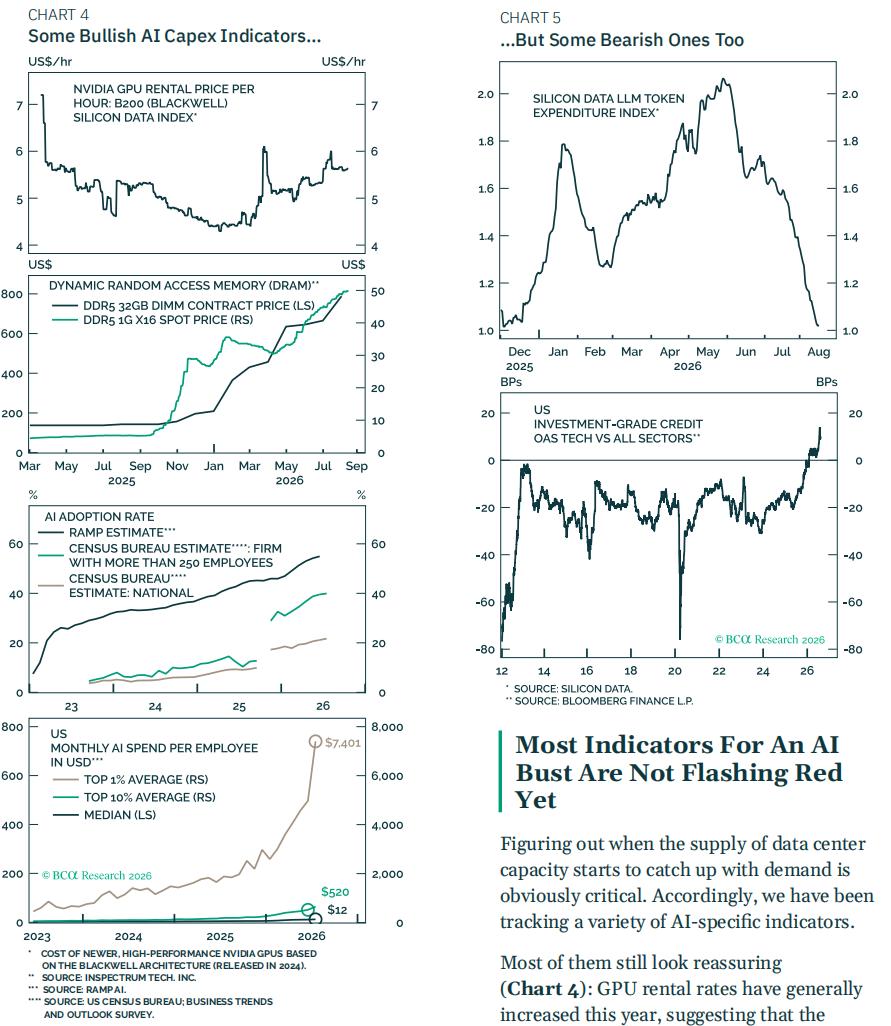
Caption: Shortages in computing power are still supporting AI investment, but signs of pressure are appearing in price, cash flow, and funding metrics.
This suggests that AI may have entered the second half of the boom cycle, but hasn’t reached the end yet.
Therefore, BCA's current view on equities is not to turn immediately bearish, but:
Remain neutral for the next three months, and slightly underweight over the next twelve months.
Their current model forecasts that US stocks’ returns over the coming months may be below the historical average, but still positive—a choppy market, not an immediate bear market.
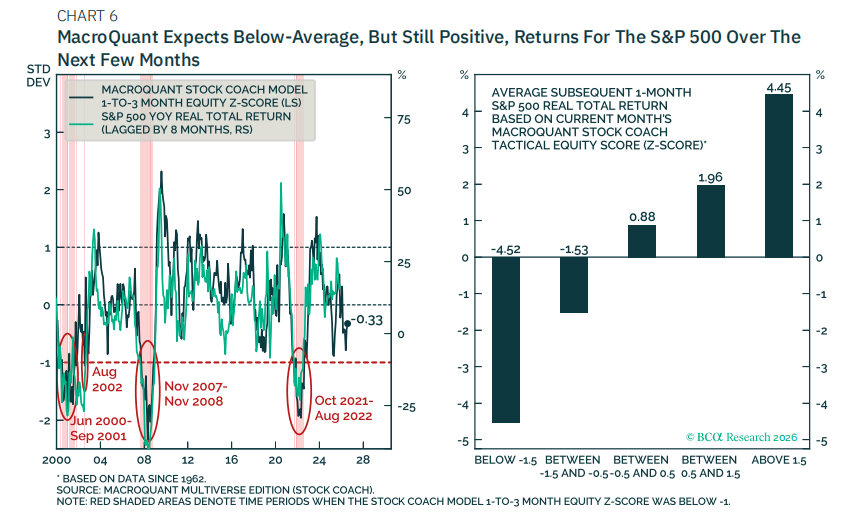
Caption: The BCA model predicts S&P 500 returns in the coming months will be below average but remain positive for now.
AI Must Ultimately Prove Itself Through Productivity
Whether capital expenditure can achieve returns ultimately depends on how much real value AI can create.
If AI can significantly improve productivity, reduce corporate costs, and create new products and services, future revenue growth might absorb today's massive investments.
But so far, the evidence is still limited.
US productivity growth in Q2 was 2.2% year-on-year, while the ten-year average is about 2.0%. In other words, productivity has not experienced a noticeable leap due to large-scale adoption of AI.
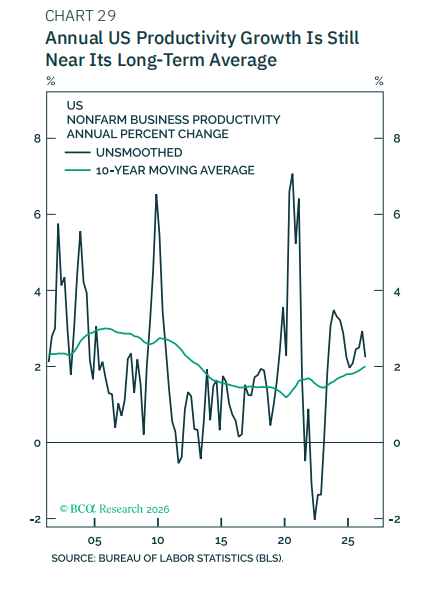
Caption: US productivity growth remains near the ten-year average, with no clear sign of an AI boost yet.
This may be the most important indicator for the future of the AI market.
Investors should not only focus on chip sales and the number of data centers, but also continuously observe:
- Whether GPU rental prices start to decline;
- Whether large tech companies’ free cash flow recovers;
- Whether usage grows fast enough after a decline in AI service prices;
- Whether macro productivity really breaks through its long-term average.
In Conclusion
The AI bubble hasn’t burst yet because computing power is still scarce, enterprise adoption rates are still rising, and capital expenditure hasn’t stopped. In the short term, AI-related stocks could even keep going up.
However, “the rally is still on” and “the business logic already adds up” are two very different things.
The real question now isn’t whether AI is useful, but whether it can generate enough revenue and cash flow in a short enough time to support today’s nearly unprecedented capital expenditure.
The bubble hasn’t burst yet, but that doesn’t mean the books balance.






