Goldman Sachs: Boldly Buy US Stocks!

👆Click the blue text to follow us
Goldman Sachs Viewpoint
This week, Morgan Stanley’s Wilson did not update his preview report, so we are replacing it with a report by Rich Privorotsky, Head of Delta One at Goldman Sachs. As the head of trading, Rich is more sensitive to market dynamics, and his analysis is, therefore, more short-term. Please interpret as needed. Let's dive into the research report.
The report starts by noting that current financial conditions are relatively loose. The VIX, which measures S&P volatility and is also known as the “fear index,” is hovering at a low level of around 14-15. Combining this with Goldman Sachs’ own data, Rich draws a few conclusions: the July deleveraging is over, the total and net exposures of both longs and shorts are now healthier, so in the short term, the equity asset class remains relatively strong.
Focusing on the AI category within equities, Rich believes the biggest winner may be the entire market, rather than one or two individual companies. He observes that the cost per token is continuously decreasing, meaning each dollar is generating more effective output. This increased efficiency will gradually enhance profitability across industries. Thus, the real winners will be all companies; if broken down further, those with minimal investment but significant AI benefits are likely to outperform.
Rich specifically mentions CoreWeave, noting its Annual Recurring Revenue (ARR) is still growing at a compound rate, and its potential market is larger than previously estimated. Most signals remain positive, alleviating much of the concern among bears. However, the key metric remains: is there free cash flow? If not, Rich says he remains unconvinced.
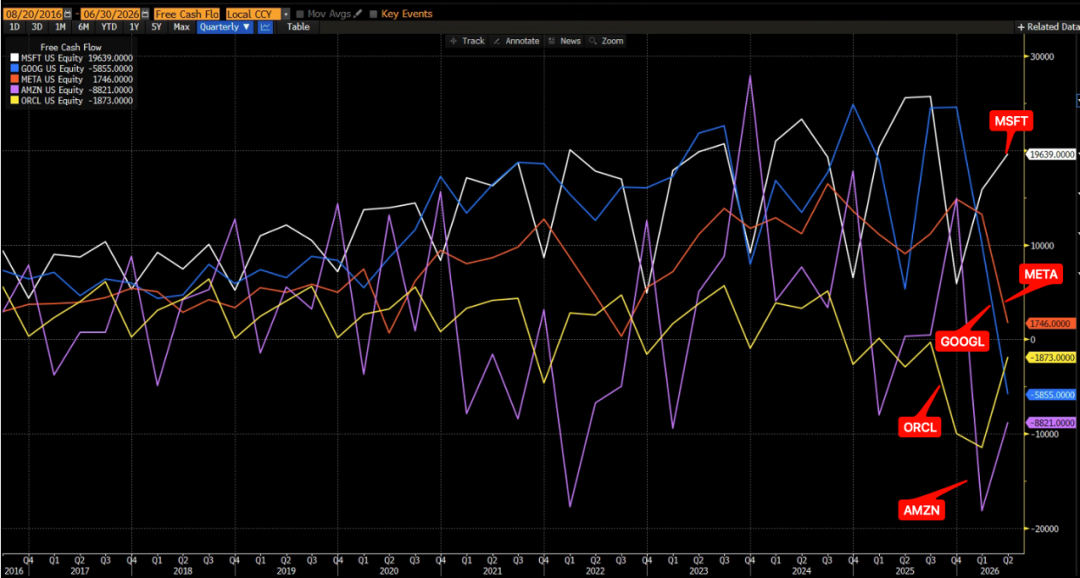
To add some context: of the Big Five Clouds, only Microsoft’s free cash flow remains consistently high; Google, previously second, quickly turned negative this quarter; Meta, previously third, saw a sharp decline this quarter. Due to business reasons, Amazon’s free cash flow has always been volatile and is now also at a historical low. Oracle, too, has faced sustained pressure from Q3 2025, but improved slightly last quarter.
In summary, the combined free cash flows of the Big Five Clouds remain under pressure and have yet to show a clear upward trend. Thus, Rich is not yet ready to fully commit his bets.
The report then moves on to the Treasury market. Rich notes that while he was on vacation, the US intervened in the yen, but he believes the actual impact was limited; indeed, the USD/JPY rate quickly returned to the pre-intervention level of around 160. After this, a global wave of long-term bond selling followed.
Rich explains that with the US running a fiscal deficit of about 6%-7% of GDP, it continues to issue large volumes of Treasuries and investment grade corporate bonds. This supply is pushing yields higher, while real rates remain elevated. Moreover, Waller’s July communication did not help the situation.
So, it's hard to attribute the slump in long-term US Treasuries to any single policy decision, but collectively, these factors have led to the current sell-off. How can this be corrected? The answer seems to point to a rate hike.
Rich observes that recent economic data has shown some weakness, giving the Federal Reserve a reason to keep rates unchanged in September. This is good for equities but will further steepen the yield curve. If the central bank fails to meet its inflation target for an extended period, it may ultimately lose credibility. Now, three Fed officials have already voted for a rate hike in July, and the long end of the bond market may ultimately force the Fed to act.
Therefore, if the Fed raises rates to restore credibility, the short end of the yield curve will rise as it is anchored by policy, but the long end isn’t constrained in the same way and may actually fall. Ultimately, the currently over-steep yield curve may flatten out.
To sum up, Rich argues that any administration will ultimately choose economic growth, tolerating slightly higher inflation. Therefore, it’s better to hold nominal assets, including the S&P 500 and gold, short or sell US Treasuries, and include cheap VIX call options in portfolios as insurance against future uncertainty.
In terms of specific sectors, Rich prefers financials, semiconductor capex chains, industrials, and broader cyclical sectors. He avoids assets lacking pricing power or those behaving like bonds—such as consumer staples, telecom, and REITs. On telecom, Rich jokes that no one in the market wants to compete with Elon Musk anymore, implying that SpaceX’s Starlink business is dominating and could eventually own the entire market. Rich tends to use shorts in staples, telecom, and REITs with defensive long positions in healthcare for balanced allocation.
In terms of risk, Rich believes oil at $80–90 per barrel remains within the economic tolerance, but crude inventories are very low and the outcome in the Middle East remains uncertain. The baseline judgment is that as the US midterm elections approach, policy makers will usually be constrained by economic rationality.
However, when markets are booming, market constraints also diminish. When the S&P 500 is at historical highs and financial conditions are very loose, war becomes more likely. Thus, investors cannot ignore geopolitical risks. Fortunately, extreme tail hedges are still very cheap.
Jason believes that in terms of asset classes, Rich prefers equities, hedges extreme tail risks with gold and VIX calls. Within equities, he favors high free cash flow and high-certainty assets such as the capex chain, financials, industrials, and broad cyclicals, while pairing with healthcare as defensive assets, forming a barbell strategy. The overall logic is clear and is worth referencing by retail investors.
Regarding US Treasuries, while a rate hike would push up short-term yields, it would also bolster Fed credibility, eventually pulling long-term yields down to ease the sell-off in long-term government bonds. I agree with this and further think that even if Waller signals a hike at the annual meeting, the US stock market won't overreact, since US Treasuries have already priced in at least one rate hike for the Fed, and a lot of expectations have been digested by the market ahead of time.
As for the future, I believe long-term yields are more likely to remain elevated, since Waller can at most reduce part of the pressure, but the rest of the support comes from large tech companies issuing debt, which is beyond Waller's control.
Given the current revenue growth rates, capex size, and free cash flow gaps of large tech, the odds of large-scale debt issuance continuing next year are high, so investment-grade bond supply is unlikely to suddenly decrease, which will support long-term yields.
So, just as in recent months, we may continue to see the “bond vigilantes’ CDs” sounding from time to time, triggering repricing. This will be tough for highly valued, highly leveraged companies with persistently negative free cash flow. On the other hand, as Rich said, defensive sectors with abundant cash flow and strong cash cow businesses will benefit. For example, I like Apple, Costco, and Walmart, among others.
From another perspective, regardless of US Treasury yields, these benchmarks are excellent long-term investment choices. While short-term returns may seem less exciting, the long-term returns are quite good.
In short, to sum up in one word: US equities always offer opportunities; when risks arise, fasten your seatbelt; balanced allocation guards against surprises; long-term compounding rewards patience.