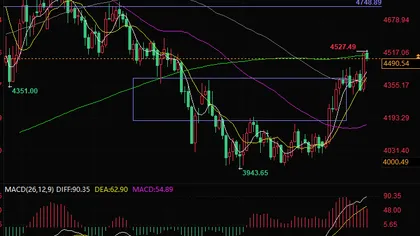
US Stock Market Preview | All Three Major Index Futures Fall, Walmart Drops After Earnings, Institutions Warn Treasury Department's Increased Long-term Bond Buybacks Unlikely to Prevent Yield Curve Steepening

On Thursday, August 20, before the U.S. stock market opened, all three major U.S. stock index futures fell.
Pre-market Market Movements
1. On Thursday, August 20th, before the U.S. market opened, futures for all three major U.S. stock indexes declined. At the time of writing, Dow Jones futures fell by 0.33%, S&P 500 index futures dropped 0.11%, and Nasdaq futures fell 0.23%.

2. As of press time, Germany's DAX index was down 0.53%, the UK's FTSE 100 index dropped 0.24%, France's CAC40 index fell 0.31%, and the Euro Stoxx 50 index decreased by 0.25%.

3. As of press time, WTI crude oil rose 3.25% to $87.13 per barrel. Brent crude oil was up 2.89% at $94.27 per barrel.

Market News
J.P. Morgan Warns: U.S. Treasury's Move to Double Bond Buybacks Lacks Credibility, Long-End Yields May Face Further Upward Pressure. J.P. Morgan strategists cautioned that the market may perceive the U.S. Treasury's unexpected action to curb long-term financing costs as lacking credibility. Over time, this could push up term premium and yields. Strategists including Jay Barry wrote in a report, “In the absence of genuine fiscal consolidation, we are concerned that the market will see this action as lacking credibility,” and, “If the Treasury becomes more speculative in its debt management methods and deviates further from its ‘regular and predictable’ principles, this could result in higher term premiums and yields over time.”
Aegon Pushes Back on U.S. Treasury: Larger Long-Bond Buybacks 'Not Meaningful', Steepening Logic Remains Unchanged. Despite U.S. Treasury Secretary Scott Besant’s efforts to curb long-term bond yields, Aegon Asset Management remains firm in its expectation that the yield spread between U.S. short- and long-term borrowing costs will continue to widen. According to Aegon portfolio manager James Lynch, increasing long-term U.S. bond buybacks is “not meaningful” and does not alter his outlook for a continued steepening of the yield curve in both the U.S. and Europe. Lynch noted, “The fiscal issues—large deficits, an influx of massive corporate debt into the market, inflation rates still above target, and the Federal Reserve’s lack of clear communication—all inject additional risk premium into the market. I don't think these factors will disappear anytime soon.”
U.S. Treasury Expansion of Long-Bond Buybacks May Heighten Inflation Risk, Analysts Say Fed Faces a More Complicated Policy Landscape. Economists and bond traders believe that if the Treasury continues to suppress long-term rates by adjusting debt structure, it could stimulate economic activity and increase inflation persistence, while also making the U.S. government's debt financing costs more sensitive to short-term rate changes. Additionally, this could further pressure the Federal Reserve’s policy independence. Joseph Brusuelas, chief economist at RSM US, said policy appears to be gradually moving toward a stance that might require central bank support for fiscal objectives. He believes the Treasury’s intervention could distort markets and make the policy environment more challenging for the Fed under Waller’s leadership. Wil Stith, senior bond portfolio manager at Wilmington Trust, commented that if inflation remains unchanged or rises further, the easing effect from lower long-term yields due to the Treasury could force the Federal Reserve to hike rates more aggressively.
AI Debt Wave Approaches—September Is the Real Test for U.S. Treasuries. While the U.S. Treasury is easing stress in the Treasury market through expanded long-term bond buybacks, another massive wave of debt financing is underway, driven primarily by AI infrastructure construction. Typically, the U.S. investment-grade corporate bond market sees an issuance peak after Labor Day. With big cloud companies increasing their funding needs, corporate bond issuance in September could reach $200 billion, posing a new challenge to an already pressured Treasury market. According to market institutions, since 2026, U.S. investment-grade corporate bond issuance has risen 38% over the year, with full-year issuance expected to hit a record $2.1 trillion. Much of the supply surge is driven by capital expenditure related to AI. This wave of supply, combined with expanding U.S. fiscal deficits, rising inflation expectations, and Federal Reserve policy uncertainty, is reshaping the fixed-income market’s supply-demand dynamics.
Is the U.S. Economy at Risk of a Sudden Collapse? Three Major Indicators Flash Red, AI Bubble Seen as the Final Straw. Tuomas Malinen, a Finnish economist specializing in financial crises and geopolitics, analyzed several key indicators in the U.S. finance and economy and concluded that while there is no clear timeline for recession, downside risks have distinctly increased. He points out that U.S. bankruptcy filings have reached the highest level since the pandemic, and the private sector yield curve is giving signals that a U.S. recession is imminent. Meanwhile, the only still-positive indicator is new orders in U.S. manufacturing, but this is insufficient to offset other risks, as current economic growth in the U.S. seems highly concentrated in only a few sectors. He is particularly concerned that the AI investment boom is forming a new market bubble. If the AI trade suddenly crashes, the economy could weaken rapidly, similar to the aftermath of the dot-com bubble burst.
Individual Stock News
Walmart (WMT.US) Q2 Results Mixed, Full-Year Guidance Below Expectations. The earnings report shows Walmart's Q2 revenue grew 6% year-on-year to $187.94 billion, beating the market expectation of $186.6 billion; same-store sales rose 2.6%, missing the expected 3.8%; adjusted EPS was $0.81, exceeding the market estimate of $0.74. In addition, the company's forward guidance was below expectations. It projects Q3 revenue growth of 3%-3.75% and adjusted EPS of $0.62–$0.64, below the expected $0.68. Walmart also forecasts full-year revenue growth of 4%-5% (previously 3.5%–4.5%), below the market expectation of 5.3%; and full-year adjusted EPS of $2.80–$2.87 (previously $2.75–$2.85), below the $2.90 market estimate. As of press time, Walmart shares were down more than 6% in U.S. pre-market trading on Thursday.
Alibaba (BABA.US) Q1 Net Profit Attributable to Shareholders Drops 75.56% Year-on-Year, AI-related Product Revenue Achieves Triple-Digit Growth for Twelfth Straight Quarter. Alibaba announced its results for the quarter ended June 30, 2026, with revenue of RMB 268.953 billion ($39.639 billion), a 9% year-on-year increase. Operating profit was RMB 15.161 billion ($2.234 billion), a 57% year-on-year decrease. Net profit attributable to ordinary shareholders was RMB 10.537 billion ($1.553 billion), a 75.56% drop. Among these, AI cloud and computing power services revenue was RMB 48.437 billion ($7.139 billion), with both total and external customer revenue accelerating to 45% year-on-year. This growth momentum was mainly driven by increased adoption of AI-related products. AI-related product revenue remained robust, reaching RMB 12.376 billion ($1.824 billion), achieving triple-digit year-on-year growth for the twelfth straight quarter.
SK Hynix (SKHY.US) Preliminary “Hefty Bonus” Plan Finalized: 60% in Shares, 40% in Cash, Average May Reach 779 Million KRW Per Person. According to an informed source, Korean chip giant SK Hynix has reached a preliminary agreement on employee compensation, planning to issue 60% of this year’s bonuses in company stock and the remaining 40% in cash. The source added that under the latest plan, employees will receive stock equal to 40% of their total bonus by 2027, with the remaining 20% of shares deferred to 2028 and 2029, and these shares will not have any lock-up period. The other 40% of the bonus will be paid out in cash in a lump sum in 2027. Additionally, SK Hynix announced on Wednesday it will repurchase and cancel treasury stock worth KRW 40 trillion (approximately $28.6 billion) and allocate over 50% of its free cash flow from 2025 to 2027 to enhance shareholder returns.
SpaceX (SPCX.US) Another Lock-up Expiry Approaches: 319 Million Shares Tradable, Investors Watching If Musk or Employees Will Sell. The second post-IPO lock-up expiration for SpaceX is approaching, with up to 319 million insider-held shares becoming tradable on August 20 local time, representing about 7% of shares held by early investors and employees. This unlock means more pre-IPO SpaceX shareholders and employees can sell their shares, and the market is watching whether this additional supply will put pressure on the stock price. However, holdings by CEO Elon Musk and certain key investors remain in longer-term lock-up and will not be affected by this round. According to Morgan Stanley analyst Adam Jonas, the overhang from the lock-up may not be a risk, but rather an investment opportunity.
IBM (IBM.US) Quantum Computing Achieves Key Milestone: Two Cryogenic Modules Successfully Connected and Cooled, Targeting World's First Fault-Tolerant Quantum Computer by 2029. IBM announced it has successfully connected and cooled two cryogenic modules in the same environment and completed initial testing. The company stated that this modular architecture aims to scale up to a shared ultra-low-temperature system connecting hundreds of quantum chips and is a critical step toward launching IBM Quantum Starling in 2029. IBM expects Quantum Starling to be the world’s first fault-tolerant quantum computer, integrating advances in error correction, processor design, decoding, and systems engineering. Compared to the most widely adopted IBM quantum systems, each vacuum enclosure per module offers up to 12 times the wiring space. IBM notes this enables more chip-to-chip connections both within and between modules, providing a hardware foundation for larger-scale quantum computing.
Key Economic Data and Events Preview
20:30 Beijing time — U.S. Initial Jobless Claims for the Week Ending August 15
20:30 Beijing time — U.S. Philadelphia Fed Manufacturing Index for August
20:30 Beijing time — 2027 FOMC Voting Member, San Francisco Fed President Daly Delivers Speech
23:10 Beijing time — 2028 FOMC Voting Member, St. Louis Fed President Musalem Interviewed by CNBC
Earnings Preview
Friday Morning: Ross Stores (ROST.US)
Friday Pre-market: KE Holdings (BEKE.US)
Disclaimer: The content of this article solely reflects the author's opinion and does not represent the platform in any capacity. This article is not intended to serve as a reference for making investment decisions.
You may also like

"Consumer Barometer" Sounds Alarm! Walmart (WMT.US) Q2 U.S. Same-Store Sales Hit 6-Year Low, Rarely Miss Expectations, Full-Year Earnings Guidance Below Expectations
Walmart's reported same-store sales fell short of expectations, a rare occurrence, due to consumers cutting back on spending.

Behind the Gold Price Surge: Short-Term Sentiment or Fiscal Policy Shift?