
Bojia Investment's Long-term Value Assessment of SpaceX

SpaceX has been publicly listed for 2 months. Since its IPO, the global investment community has held two extremely polarized views about SpaceX's value: one is a romantic vision of Mars colonization, while the other is cautious skepticism regarding commercial monetization. These rival forces are fiercely competing in the capital markets, which also fuels SpaceX's stock price volatility.
In the short term, market sentiment's impact on stock price is uncontrollable. However, judging SpaceX's long-term value can help focus on a few core factors that create enduring and decisive influence.
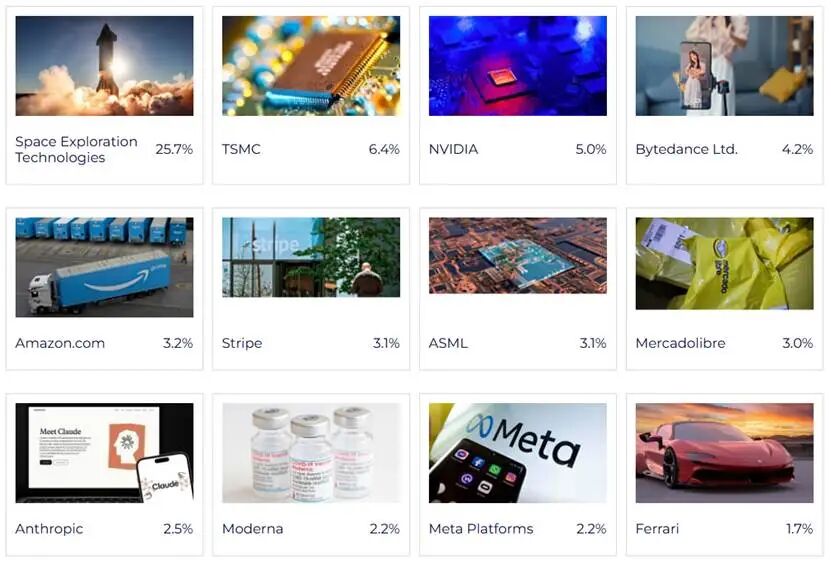
In this regard, long-term growth investment expert Baillie Gifford should have significant authority. Since 2018, Baillie Gifford has invested in SpaceX, achieving returns in excess of 10 times its original capital. Baillie Gifford’s flagship product, the Scottish Mortgage Trust (SMT), has benefited greatly from the long-term appreciation of SpaceX. Due to the overweight exposure and rapid price appreciation, SMT in April 2026 amended its investment policy to allow an additional investment of £250M beyond its 30% non-listed assets cap (at that time SpaceX was still a private company). According to the latest Q2 data, SpaceX alone accounts for more than 25% of SMT’s total positions.
Baillie Gifford’s perspective on SpaceX offers us an extremely insightful lens. In a recent in-depth interview, Baillie Gifford presented a unique and highly penetrating analytical framework. They not only reveal SpaceX’s past and present, but also lay out the internal logic of how it has evolved from a “sci-fi concept” to a “core asset” and sketch a grand business blueprint centered on space infrastructure. We will summarize the interview’s core content along the dimensions of paradigm shift, value assessment, growth trajectory, potential risks, the flywheel effect, etc., in-depth analyzing Baillie Gifford’s investment rationale and future vision for SpaceX.
For Baillie Gifford, the knowledge leap regarding SpaceX was not instant, but built upon firm technical verification and deep economic insight. Analyst Luk Ward, with his engineering background, kept a close eye on SpaceX even before its rise to fame. The real turning point came in 2015, when the Falcon 9 rocket achieved vertical landing for the first time. This historic moment validated the feasibility of reusable technology to the market and directly contributed to Baillie Gifford’s investment decision.
In Baillie Gifford's view, SpaceX is far from a traditional “cost center” within the aerospace industry. Their core logic is that SpaceX, through disruptive technological innovation,
More ingeniously,
In assessing SpaceX’s business value, Baillie Gifford offers a historical analogy:
To achieve this monopolistic position, SpaceX abandoned the traditional path of aerospace companies relying on outsourced supply chains, which are often hampered by political balancing and personal relationships. With its massive balance sheet and “blank slate” advantage, SpaceX brings every step of the value chain in-house, achieving genuine vertical integration and system-level optimization. This mode generates an immensely positive flywheel effect in economics:
The ultimate manifestation of this vertical integration and cost control is the cliff-like drop in launch costs. From approximately $1,000 per kilogram during the Falcon 9 era to a future where Starship could lower costs to $100 per kilogram or even $10 per kilogram—each magnitude of reduction unlocks an entirely new commercial market.
In Baillie Gifford’s eyes, SpaceX’s growth is not just about increased launch frequency, but more importantly its ongoing ability to push down the cost curve and unlock new markets. Starship’s development does not follow the logic of “good enough—no further improvement needed,” but aims to access entirely new fields such as space manufacturing, orbital data centers, lunar mining, and space laboratories.
Among current business lines, Starlink still holds tremendous growth potential. As satellite numbers rise and antenna costs fall, Starlink’s user base will expand from remote areas to urban consumers. Crucially, the breakthrough in “direct-to-cell” technology means that any ordinary SIM device can access global communication networks, which has immense commercial significance for applications such as autonomous robots, agriculture, mining, and emergency rescue.
In addition, Baillie Gifford believes that SpaceX’s acquisition of xAI (Grok’s parent company) may seem like a cross-sector move but is, in fact, a natural extension of rocket technology innovation. Building AI data centers faces three main cost factors: chips, power, and construction costs. The latter two are nearing the end of their S-curves on Earth, with limited room for expansion. Space-based data centers perfectly solve these constraints—space offers 24-hour uninterrupted solar energy, satellites can be mass-produced in factories before launching, and launch costs are dropping with Starship’s progress. Although the current economics of space-based AI remain debatable, projecting Earth versus space cost curves into the future suggests that orbital data centers might become more economical than terrestrial ones, giving SpaceX a much more scalable computing infrastructure than its competitors.
SpaceX’s investment experience has even inspired Baillie Gifford in other sectors. For instance, SpaceX’s progress in heavy launches left room for smaller players (like Rocket Lab), while unmet demand for “sovereign-only satellites” not covered by Starlink drove their investment in Astranis. Baillie Gifford even applies this “flywheel thinking” across industries, such as with construction technology companies.
For any investment, focusing only on opportunities while ignoring risks is a recipe for failure. Baillie Gifford also openly addresses SpaceX’s controversies and risks. The first is timeline delays. SpaceX has a historical tendency toward over-optimistic timing forecasts,
Next, there are risks of misjudging the competitive landscape. Baillie Gifford reflects in this interview that while they once assumed SpaceX’s scale and rewards would attract mature competitors, in reality, similar-looking firms have not matched SpaceX in product and business innovation nor grown to comparable scale. Additionally, Musk’s acquisitions of Twitter and xAI introduced extra unforeseen investment complexity.
On the engineering side, space data centers confront extreme challenges such as heat dissipation in a vacuum—which are much more difficult than on Earth and demand further thought. Moreover, from today’s perspective,
Looking back on the SpaceX investment, it is a crystallization of Baillie Gifford’s core investing style. First is an extreme commitment to the long-term; Baillie Gifford entered decisively eight years before SpaceX’s IPO, preferring to understand the company via years of private interactions rather than through limited IPO window disclosures. Second is their specialty in private companies: by observing capital allocation and responses to adversity in both good and bad times, they gain high conviction in management’s capabilities.
This investment also reflects Baillie Gifford's strong founder orientation—favoring ambitious visionaries willing to “reimagine the market” and pay a premium for that ability. Analytically, they insist on system-level thinking—not just on products, but the company’s vertical integration ability. Finally, the “flywheel effect” has become a core filter for their other investments, constantly seeking great companies that are self-reinforcing and continually redefining their boundaries. This provides a valuable template for understanding the long-term value of cutting-edge technology companies.
Of course, personally, there are still parts of this investment logic that I don’t fully grasp—chiefly, the feasibility of the space data center scenario and how the xAI acquisition fits into the investment logic chain. Perhaps, this is precisely why we so often miss “world changers.”
Source: Baillie Gifford in-depth interview "SpaceX: past, present, future", click “View Original”



Disclaimer: The content of this article solely reflects the author's opinion and does not represent the platform in any capacity. This article is not intended to serve as a reference for making investment decisions.
You may also like
mRNA personalized cancer vaccine! What does Moderna’s breakthrough mean?
Goldman Sachs, Citibank, and JPMorgan Chase all believe that Moderna's breakthrough means that mRNA technology has successfully unlocked the oncology pipeline, significantly reducing the risk of melanoma recurrence and metastasis, and demonstrating the enormous potential of mRNA in non-respiratory diseases, setting a milestone in tumor immunotherapy. Goldman Sachs is optimistic about its potential across multiple cancer types; JPMorgan Chase and Citibank are more cautious, pointing out that the commercialization threshold for personalized customization is high, and the efficacy for other cancer types still needs to be verified.
Is the familiar gold bull market back? The U.S. Treasury to repurchase long-term bonds, $4,500 may become the starting point for a new surge
After the U.S. Treasury unexpectedly took steps to control long-term borrowing costs, gold prices recorded their largest increase in six months. The U.S. Treasury announced that it will expand the scale of liquidity support repo operations for 10-year to 30-year securities.

Aave Horizon to onboard fixed-income fund from Neuberger Berman and Securitize


