
Why did gold suddenly fluctuate by $100? Long-term bond repurchase volume suddenly doubled

FX678 News, August 19—— On Wednesday, August 19, the US Treasury announced an expansion of the liquidity support repurchase for long-term nominal Treasury bonds, increasing the single-operation upper limit of the 10-20 year and 20-30 year maturity intervals from $2 billion to at least $4 billion, with implementation planned to begin on September 9. After the announcement, long-term Treasury yields fell sharply, with the 30-year US Treasury yield dropping to about 5.20% and the 10-year yield falling to around 4.63%. These changes in interest rates were quickly transmitted to the precious metals market, and the current spot gold price has approached $4,460 per ounce.
On Wednesday, August 19, the market experienced a significant cross-asset repricing. Previously, long-term Treasuries had been under continuous pressure, with the 30-year US Treasury yield once climbing to its highest level since 2007. The US Treasury then announced the expansion of long-term nominal Treasury bond liquidity support repurchases, raising the single-operation upper limit of the 10-20 year and 20-30 year maturity intervals from $2 billion to at least $4 billion, to be implemented from September 9. After the news was released, long-term Treasury yields quickly retreated, with the 30-year US Treasury yield dropping to about 5.20% and the 10-year yield near 4.63%. This movement in interest rates rapidly transmitted to the precious metals market, with spot gold climbing to around $4,460 per ounce.
Understanding this rare gold move, the key is not to simply equate “Treasury buybacks mean gold will rise” in a linear fashion, but to re-examine the actual holding costs faced by gold.
Gold itself does not yield coupons, so the market typically compares the opportunity cost of holding gold versus high-credit-quality fixed income assets. Previously, the 30-year Treasury yield rose to around 5.3% while long-term inflation expectations did not increase by the same margin, indicating a tightening in the real interest rate environment. This was also an important reason why gold, even with persistent geopolitical risks, failed to perform as a traditional safe-haven asset.
On August 18, the 30-year US Treasury yield climbed to about 5.327%, a high since 2007, and the 10-year yield was also near 4.7%. After the US Treasury announced the expansion of long-end repurchases, the first market adjustment targeted the liquidity risk premium and term premium for long-term bonds, rather than immediately re-pricing Federal Reserve policy rates.
This distinction is very important. Treasury buybacks are a debt management and liquidity support measure and are not equivalent to Federal Reserve asset purchases, let alone can be simply described as quantitative easing. Their direct effect is to improve the liquidity of specific old issues, provide additional buyer demand, and reduce the liquidity compensation the market demands during periods of concentrated supply pressure.
By the end of July, the cumulative size of the US Treasury's long-term nominal bond liquidity support repurchases had reached about $95 billion, indicating that the repurchase mechanism is not a new or temporary tool. What truly deserves market attention this time is the significant increase in the single-operation size for long maturities.
This move again demonstrates an often-overlooked fact: there is no stable one-to-one relationship between gold and nominal Treasury yields—real interest rates are the more important intermediate variable.
During gold's notable decline on August 18, the market observed a rapid rise in long-term Treasury yields, while long-term inflation expectations remained relatively stable. When nominal yields rise faster than inflation expectations, real yields rise, increasing the relative opportunity cost of holding a non-interest-bearing asset. Data at the time showed that the 10-year breakeven inflation rate was around 2.30%.
The logic on August 19 reversed. After the US Treasury expanded its repurchases, the 30-year yield fell significantly from its previous closing level of 5.284%, compressing the term premium that the market had previously concentrated on pricing in. At the same time, the US Dollar Index weakened briefly, giving gold a simultaneous re-pricing via both interest rate and currency channels.
However, this does not mean that long-term interest rate risks have disappeared. Fiscal deficits, the scale of Treasury supply, corporate financing demands, and energy prices can still impact the long-term term premium. The US Treasury's early-August quarterly financing schedule still maintains a large amount of debt issuance and continues to use repurchases to improve secondary market liquidity.
Therefore, what gold currently reflects is not simply an increase in “safe-haven premium,” but rather a concentrated repricing correction after a rapid adjustment in real interest rates that compressed the previous trading day's valuations.
The key contradiction in today's long bond market is the coexistence of increased liquidity support and structural supply pressure.
The Treasury's increase of repurchase size can improve the market depth of old issues at specific maturities but cannot directly alter the overall fiscal funding need. The previous quarterly plan shows that liquidity support repurchase volumes have remained at the tens-of-billions level, while the overall size of the US Treasury market has surpassed $30 trillion. Therefore, relative to the entire stock of the market, repurchases are better viewed as microstructural tools rather than basic tools for changing the debt supply-demand fundamentals.
On the other hand, energy prices are still an inflation variable. Recently, crude oil prices have remained at high levels, and geopolitical tensions in the Strait of Hormuz have raised uncertainties around transportation and energy supply, leading bond investors to continue demanding higher long-term inflation risk compensation. Earlier on August 19, the 30-year US Treasury yield was still around 5.22% and the 10-year yield about 4.625%, showing that although there was a correction in the long bond market, absolute rates are still high.
This places gold in a complex macro mix: energy and geopolitical risks increase demand for safe-haven and inflation-hedging, but higher real interest rates raise the opportunity cost of holding gold. The simultaneous presence of these factors also explains why gold has experienced significant intraday swings in recent sessions, rather than a smooth trend dominated by a single macro variable.
From the 10-minute chart structure, the most notable change for gold is not a breakthrough in price, but a shift in volatility regime.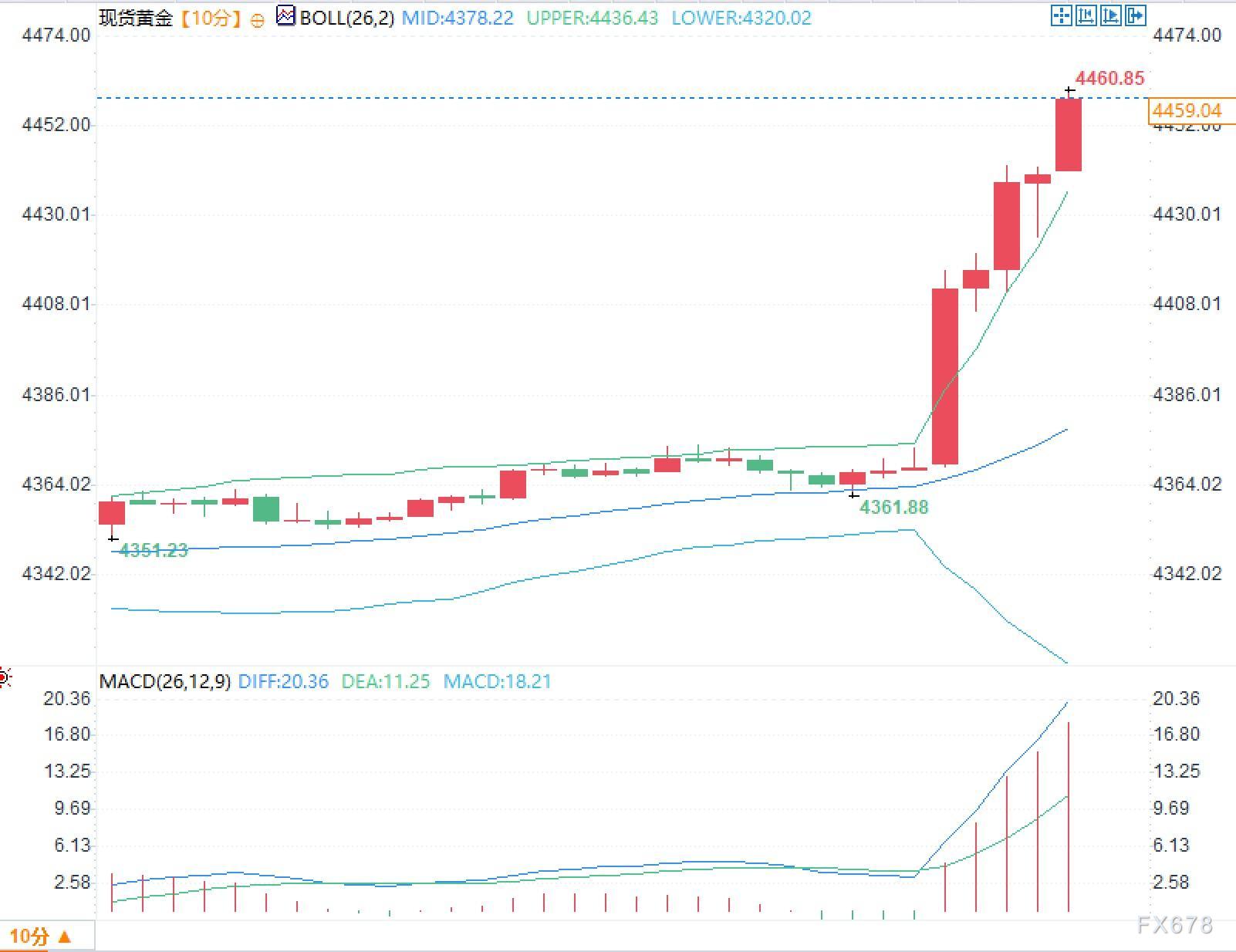
Previously, prices moved within a narrow range near the middle Bollinger Band, followed by a series of large real-bodied candlesticks and a rapid expansion of the upper Bollinger Band and a simultaneous rise in the middle band. Currently, the middle Bollinger Band is around $4,378 per ounce and the upper band around $4,436 per ounce, while intraday prices have clearly traded beyond the upper band. This condition usually means that short-term realized volatility has already exceeded previous statistical ranges, rather than merely reflecting trend strength. The MACD also exhibits a rapid expansion of short-term momentum, with the gap between DIFF and DEA increasing significantly, and histogram values rising quickly.
Currently, gold, long-term Treasuries, and the dollar have been repriced simultaneously after the Treasury news, indicating that this round of volatility is mainly driven by macro rate factors rather than internal gold market elements. Going forward, market attention should focus on real yields, term premium, Treasury auction demand, energy prices, and how the Federal Reserve minutes describe the policy function.
Disclaimer: The content of this article solely reflects the author's opinion and does not represent the platform in any capacity. This article is not intended to serve as a reference for making investment decisions.
You may also like
Self launches stablecoin distribution program for USA₮ on Celo
Circle explores Arc’s post-quantum security roadmap for USDC
Morning Minute: SEC Brings Clarity to Crypto
Chart of the Day: Toast Setup Points to Continued Upside -- Barrons.com


