
Bitget UEX Daily | Treasury Options Shift to Pricing in 2027 Rate Cuts; September Hike Expectations Cool Sharply; AI Industry Chain Under Broad Pressure (August 19, 2026)
 Bitget2026/08/19 00:58
I. Hot News Highlights
Federal Reserve Dynamics
Treasury options shift to pricing in 2027 rate cuts; September hike expectations cool markedly
- After weaker July inflation, retail sales and consumer confidence data, coupled with an unexpected 23,000 decline in non-farm payrolls, interest-rate options markets began positioning for a potential Fed policy reversal.
- Investors bought September-expiry options betting on a hold, while also accumulating March and June 2027 SOFR call options.
- The probability of a September hike has dropped from a recent peak of about 68% two weeks ago to roughly half; interest-rate swaps now imply only about 9 basis points of tightening at the September meeting. Market Impact: Repricing of the policy path eases some tightening concerns, yet long-term yields remain elevated. The divergence between short-end and long-end expectations is creating differentiated pressure on growth stocks.
International Commodities
Trump pauses contact with Iran; geopolitical stalemate continues
- A U.S. official said President Trump has instructed the negotiation team (including Vice President Vance, special envoy Witkoff and Kushner) to suspend contact with Iran.
- White House strategy has shifted from “strike hard and fast” toward a longer-term approach of “choking Iran’s throat,” following earlier positive discussions. Market Impact: Suspension of Hormuz-related talks heightens supply uncertainty, providing geopolitical support for oil prices and prolonging sticky-inflation concerns.
Macroeconomic Policy
Multiple U.S. states tighten data-center power regulations; AI infrastructure becomes a midterm election issue
- Pennsylvania requires data-center developers to secure their own power supply and raise clean-energy usage ratios; Texas has launched grid-connection audits; New York has paused new large-scale data centers.
- Bank of America strategists list data-center regulation as a midterm-election variable; tighter rules could affect the pace of AI capital expenditure. Market Impact: Power and community constraints raise the cost and uncertainty of AI infrastructure deployment, drawing attention to related equipment and power suppliers while pressuring tech-hardware valuations.
II. Market Review
Commodities & Forex Performance
- Spot Gold: Approx. $4,343/oz, +0.2%
- Spot Silver: Approx. $63/oz, -0.52%
- WTI Crude: Approx. $85/bbl, +0.87%
- Brent Crude: Approx. $89/bbl, +0.56%
- US Dollar Index (DXY): Approx. 99.645, little changed
Driver Analysis: Trump’s pause in contact with Iran prolongs Hormuz uncertainty and supports oil prices. Gold is oscillating between rising rate-cut expectations and elevated long-term yields, while silver shows mixed industrial and safe-haven influences. Treasury options indicate a sharp drop in September hike odds, yet the 30-year yield remains high, limiting precious-metal upside. Institutional views hold that near-term commodities are jointly driven by geopolitics and interest-rate path repricing; elevated oil prices may reinforce the sticky-inflation narrative, creating a linkage of geopolitical stalemate → oil support → inflation expectations → policy-path reassessment.
Cryptocurrency Performance
- BTC: Approx. $64,600, +0.31%
- ETH: $1,915, +0.32%
- Crypto Total Market Cap: $2.29 trillion, +0.2%
- Market Liquidations: 24h total liquidations $205 million, of which long liquidations $119 million
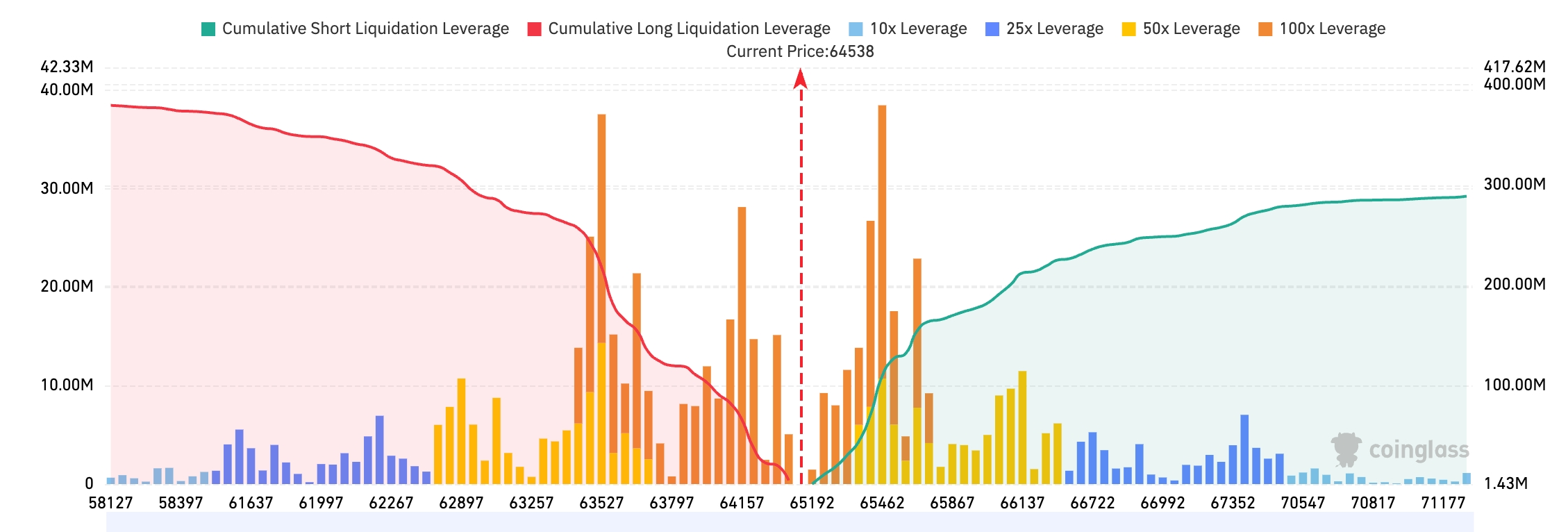
- Bitget BTC/USDT Liquidation Map: Current BTC price around $64,538. Dense high-leverage (50x/100x) short liquidation clusters sit in the $65,000–$66,000 zone above; a break higher could trigger successive short covering and amplify upside momentum. Long liquidation pressure in the $63,000–$64,000 area below has been partially released, with short-term leverage focus clearly skewed upward.
- Spot ETF Net Flows: Yesterday net inflow of $298 million; current dynamic net inflow $46 million
Driver Analysis: The pullback in U.S. AI stocks and elevated long-term yields have dampened risk appetite, leaving crypto in a range-bound mode. Whales have net accumulated approximately 43,000 BTC over the past 60 days, indicating continued medium- to long-term buying on dips. ETF flow volatility coexists with leverage liquidations; institutional consensus points to range-bound trading, with attention on interest-rate path repricing and geopolitical developments for risk-asset transmission.
US Equity Index Performance

- Dow Jones: Closed at 53,343.40, -0.22%
- S&P 500: Closed at 7,691.76, -0.69%
- Nasdaq: Closed at 26,289.71, -1.33%, with tech and semiconductors the main drag
Tech Giants Dynamics
- NVDA: Approx. $219.74, -2.34%
- AAPL: Approx. $310.03, +1.45%
- MSFT: Approx. $481.63, +0.27%
- GOOGL: Approx. $344.20, +0.06%
- AMZN: Approx. $259.45, -0.71%
- META: Approx. $543.67, -4.45%
- TSLA: Approx. $336.87, -0.72%
Performance Summary & Driver Analysis: The Mag 7 showed clear divergence. Apple, Microsoft and Google were relatively resilient or higher, while Nvidia and Meta led the declines. AI hardware and semiconductor names came under significant valuation and regulatory pressure, prompting partial rotation into software and defensive sectors. Treasury options signal earlier rate-cut expectations, yet elevated long-end yields and tighter data-center regulations jointly weigh on high-capex growth stocks, producing differentiated individual-stock drivers.
Sector Movers Observation
Semiconductors / Memory – Sharp Pullback
- Representative stocks: SK Hynix -approx. 9.2%, SanDisk -approx. 9.01%, Broadcom -approx. 3.17%.
- Drivers: Cooling AI enthusiasm, valuation digestion and spillover from the Korean market led capital to exit hardware segments.
Optical Communication – Significant Declines
- Representative stocks: Coherent -approx. 12.75%, Lumentum -approx. 9.87%.
- Drivers: Temporary cooling of AI optical-module demand expectations; high beta amplified the drawdowns.
Pharmaceuticals & Dividend Names – Relative Strength
- Representative stocks: Johnson & Johnson hit a closing record high; Eli Lilly and peers approached all-time highs.
- Drivers: Capital rotated from high-valuation AI themes into defensive and steady-growth sectors.
III. In-Depth US Equity Analysis
1. Coherent (COHR) – Optical Communications Leader in Sharp Pullback
Event Overview: Coherent shares fell approximately 12.75% in a single session, one of the steepest declines in the AI optical-communications group. The company had previously reported better-than-expected fiscal Q4 results (revenue ~$2.05 billion, +34% YoY; non-GAAP EPS $1.74) and issued above-consensus guidance for the next quarter, driving a >7% surge the prior day. On August 18 clear profit-taking emerged; the simultaneous launch of the Tradr 2X Short COHR Daily ETF (COHQ) provided a leveraged vehicle for bearish positioning and further amplified the decline. Market Interpretation: Institutions view the move primarily as technical correction of a high-beta name after earnings delivery, compounded by broader risk-off sentiment in AI hardware and whispers that Anthropic’s revenue fell short of some market expectations. Fundamentals remain intact, yet near-term valuation digestion and the new inverse product increased volatility. Investment Implications: The optical-communications demand thesis is unchanged, but high volatility requires stricter position and timing management; monitor subsequent orders and capacity ramp.
2. Lumentum (LITE) – Optical-Module Peers Under Pressure
Event Overview: Lumentum declined approximately 9.87%, moving in tandem with Coherent, Credo and other optical names. Market pressure is attributed to digestion of elevated AI optical-interconnect valuations, profit-taking after the prior session’s gains, and the broader semiconductor/AI-hardware sell-off. Market Interpretation: Analysts note that the optical group had run hard, with elevated static valuations; any macro or sentiment shift triggers rapid retracement. Firms such as William O’Neil maintain Buy ratings, yet near-term flows have rotated toward defensive and software names. Investment Implications: As a core AI data-center optical-module supplier the medium-term thesis remains valid, but valuation swings and sector rotation risks warrant caution.
3. Credo Technology (CRDO) – High-Speed Connectivity Chip Leader in Declines
Event Overview: Credo Technology fell approximately 13%, among the largest drops in AI optics and high-speed connectivity names. The company benefits from data-center SerDes and optical-interconnect demand but was caught in the August 18 AI-hardware and optics sell-off. Market Interpretation: Institutions regard the decline as largely a sector-wide risk-appetite reduction and digestion of prior gains rather than a sudden fundamental deterioration. High beta magnified the move when sentiment turned. Investment Implications: Suitable as a high-beta AI-infrastructure allocation, yet close monitoring of data-center capex cadence and competitive dynamics is required.
4. SanDisk (SNDK) – Memory Sector Sharp Retreat
Event Overview: SanDisk dropped approximately 9%, moving lower with Micron, Seagate and other memory-related names. Markets are concerned about elevated rates pressuring growth valuations and a temporary cooling of AI storage demand expectations. Market Interpretation: Analysts still see medium- to long-term support from the storage cycle and AI demand, but near-term pressure from high long-term yields and rotation out of hardware is evident. Some memory names had surged the prior session on policy and demand narratives before profit-taking set in. Investment Implications: The storage supply-demand gap thesis remains intact, yet near-term volatility has increased; watch upcoming earnings and capex guidance.
5. Apple (AAPL) – Closed Higher Against the Tech Sell-Off
Event Overview: Apple rose approximately 1.45%, showing relative strength while the Nasdaq fell sharply and AI hardware sold off broadly; it was one of the few Mag 7 names to finish higher. Market Interpretation: Institutions view Apple as a relatively defensive tech allocation; the hardware cycle and services business provide a buffer, drawing flows when high-valuation AI hardware is sold. Investment Implications: Suitable as a steadier exposure within the tech sector; monitor new-product cycles and AI-feature adoption for longer-term growth contribution.
IV. Market & Project Updates
- Treasury options markets have pivoted significantly toward pricing in 2027 rate cuts; the probability of a September hike has fallen from recent highs to roughly half.
- VanEck research notes that 8 of its 12 market-capitulation indicators have triggered, suggesting Bitcoin’s nearly 11-month pullback may be nearing an end. BTC has traded in a $58,000–$66,500 range since June and currently sits near $64,700, still about 48% below its October 2025 all-time high. U.S. spot Bitcoin ETFs recorded nearly $300 million in net inflows on Monday, the strongest single day since May 5. VanEck observes that the prior three Bitcoin bear-market cycles averaged 12.7 months from peak to maximum drawdown; the current cycle is in its 11th month, historically pointing to a possible accumulation phase in September–November. The team cautions, however, that clustered capitulation signals have not always produced strong short-term returns—90- and 180-day average returns in similar episodes have lagged the market benchmark. Long-term holders have also reduced positions by about 356,000 BTC over the past 30 days, bringing holdings to 11.84 million BTC and the share of circulating supply below 60% for the first time in months.
- The U.S. Securities and Exchange Commission has proposed a new “Regulation Crypto Assets” framework aimed at providing a compliant path for digital-asset offerings while allowing certain exemptions from securities-law registration. Described as a “tailored offering regime,” it seeks to facilitate capital raising while protecting investors. The proposal includes a “startup exemption” permitting offerings of up to $5 million over four years without Securities Act registration, and a “financing exemption” for offerings of up to $75 million over one year. A safe-harbor provision would allow a digital asset to cease being treated as a security once specific conditions are met and “all managerial efforts” have stopped. The comment period is 60 days.
- Bitcoin whales have net accumulated approximately 43,000 BTC over the past 60 days; medium- and ultra-large holders have also accelerated buying.
- Anthropic plans to expand its credit facility and is advancing a possible autumn IPO; its revenue has already surpassed OpenAI’s. OpenAI reported Q2 revenue of $6.7 billion (up 18% from $5.7 billion in Q1), yet operating losses widened further. Some investors expressed disappointment that OpenAI’s growth lagged competitor Anthropic.
- Bank of America analyst Vivek Arya, using a free-cash-flow sum-of-the-parts valuation, estimates Nvidia’s current share price trades at a 34%–50% discount to fair value even after incorporating ecosystem-financing risks. He argues the market may be overestimating Nvidia’s AI-investment risk, creating an “attractive buying opportunity.” Nvidia has committed roughly $300 billion in funding to projects such as OpenAI’s Ohio data-center campus and ecosystem partners (about $70 billion equity and $230 billion in residual-value guarantees or repurchase commitments). BofA maintains a Buy rating and $350 price target on Nvidia.
V. Today’s Market Calendar
Data Release Schedule
| Ongoing | United States | Related economic data and Fed speakers | ⭐⭐⭐ |
Key Event Preview
- US-Iran contact dynamics: Continue monitoring developments after Trump’s pause in negotiations.
- Data-center regulation: Watch state-level policy implementation and its impact on AI capex.
- AI company updates: Anthropic financing and potential IPO progress.
August 19 (Wednesday)
- ★★★★★ Fed releases July FOMC minutes (evening Beijing time) – the most important macro event of the week after last week’s CPI. Focus on details of the three dissenting votes against a hold, discussion of sticky inflation, the labor market and the September policy path.
- Target (TGT), Lowe’s (LOW), TJX and Analog Devices (ADI) report before the open – testing retail-consumption health and semiconductor/AI-related demand (ADI: industrial, data-center power and communications).
- EIA crude-oil inventory data.
August 20 (Thursday)
- U.S. August Philadelphia Fed Manufacturing Index, weekly initial jobless claims, July Leading Index.
- ★★★★ Walmart (WMT) reports before the open – key test of lower-end consumption resilience, grocery and general-merchandise demand; Alibaba (BABA), NetEase (NTES), Deere (DE) and others also report.
- Ross Stores and others after the close.
August 21 (Friday)
- ★★★★ U.S. August S&P Global Manufacturing/Services PMI flash – verifying expansion momentum and soft-landing continuity.
- Relatively few other major events.
After last week’s softer CPI/PPI, rate-hike expectations have cooled markedly. If the minutes show limited divergence and retail/housing data remain solid, the soft-landing trade and growth stocks may continue; conversely, more hawkish minutes or weak consumer guidance could re-price tightening and test high-valuation sectors. Moderate-to-elevated volatility is expected; focus on minutes language and the pricing reaction to retail-earnings beats or misses.
Institutional Views
Investment-bank analysts note that Treasury options show a clear cooling of September hike expectations, providing some buffer for risk assets via policy-path repricing. However, elevated long-end yields and digestion of AI-hardware valuations continue to pressure growth stocks. Trump’s pause in contact with Iran prolongs geopolitical uncertainty and supports oil. Tighter data-center regulations raise constraints on AI infrastructure deployment, prompting rotation from semiconductors and optical communications into pharmaceuticals, software and other sectors. Crypto remains range-bound amid whale accumulation and ETF flow volatility. Overall strategy recommendation: monitor interest-rate path reassessment and regulatory implementation progress, remain cautious on high-valuation AI hardware, and watch the sustainability of defensive-sector strength.
Disclaimer: The above content is compiled by AI search and verified by humans for publication only. It does not constitute any investment advice. Data in the text may inevitably contain deviations; please refer to real-time market data.
Disclaimer: The content of this article solely reflects the author's opinion and does not represent the platform in any capacity. This article is not intended to serve as a reference for making investment decisions.
You may also like
From the surge in global stock markets and the resilience of gold to arbitrage opportunities in emerging markets, the underlying assumption for this year’s cross-asset trends is that “real interest rates will decline”—but is this really the case?
Goldman Sachs analysis points out that the current cross-asset boom in the stock market, gold, emerging market arbitrage, and narrowing credit spreads essentially shares the same logic: real interest rates are expected to decline soon. However, the U.S. 10-year real yield remains at a relatively high level of around 2.50%, and the key premise has not yet materialized. Goldman Sachs advises not to fight against the arbitrage narrative for now, but to control positions and take cues from the direction of real interest rates as the ultimate basis for judgment.
TACO Returns! Trump Temporarily Delays 50% Tariffs on Canada; $20 Billion Worth of Goods Temporarily Spared from Tariff Storm
U.S. President Donald Trump announced on Tuesday evening that he will postpone by three days the new 50% tariffs on Canadian goods that were scheduled to take effect on Wednesday, stating that the two countries have reached an agreement.

Wintermute: Bitcoin Range Breakout Delayed by ETF Outflows and Miner Selling
Why not buy storage stocks? Here are the answers from two industry leaders
As the AI infrastructure boom drives up storage chip stocks, Ark Invest's Cathie Wood and tech analyst Ben Thompson have chosen to stay away. Wood warns that prices multiplying several times is a negative signal, pointing out that inference chips from companies like Cerebras and Groq have already circumvented high-bandwidth memory at the engineering level. Thompson uses Iran's blockade of the Strait of Hormuz as an analogy—playing this card will only accelerate opponents in finding alternatives. The highlight moment for storage may actually mark the starting point of its replacement.


