
web3: Satoshi’s $70 billion Bitcoin wallet sparks renewed discussions on private key security

Discussions about Satoshi Nakamoto's Bitcoin holdings have heated up again recently. A claim circulating on social platforms suggests that anyone who randomly guesses a private key or mnemonic phrase could potentially obtain this batch of Bitcoin, worth around $70 billion. Technical experts soon pointed out that this notion ignores the fundamental facts of Bitcoin’s key system, making it practically impossible in real life.
Holding Size Becomes the Focus Again
On-chain data platform Arkham Intelligence estimates that addresses associated with Satoshi Nakamoto currently hold about 1.096 million BTC. Using the quoted price in the article of $64,245 per coin, the corresponding market value is approximately $70.43 billion. This scale has long been considered one of the most closely watched dormant holdings in the Bitcoin market.
However, the core of this round of discussion isn’t the size of the holdings itself, but whether “brute force cracking could obtain these assets.” Some opinions simplify the problem to guessing 24 words consecutively, but researchers believe this description is inaccurate.
Not Controlled by a Single Mnemonic Set
Technical experts pointed out that Satoshi’s early Bitcoin holdings were not managed by a single set of modern mnemonic phrases. The wallet mnemonic standard BIP-39 commonly used today appeared much later; between 2009 and 2010, the method of generating Bitcoin keys was different from the present system.
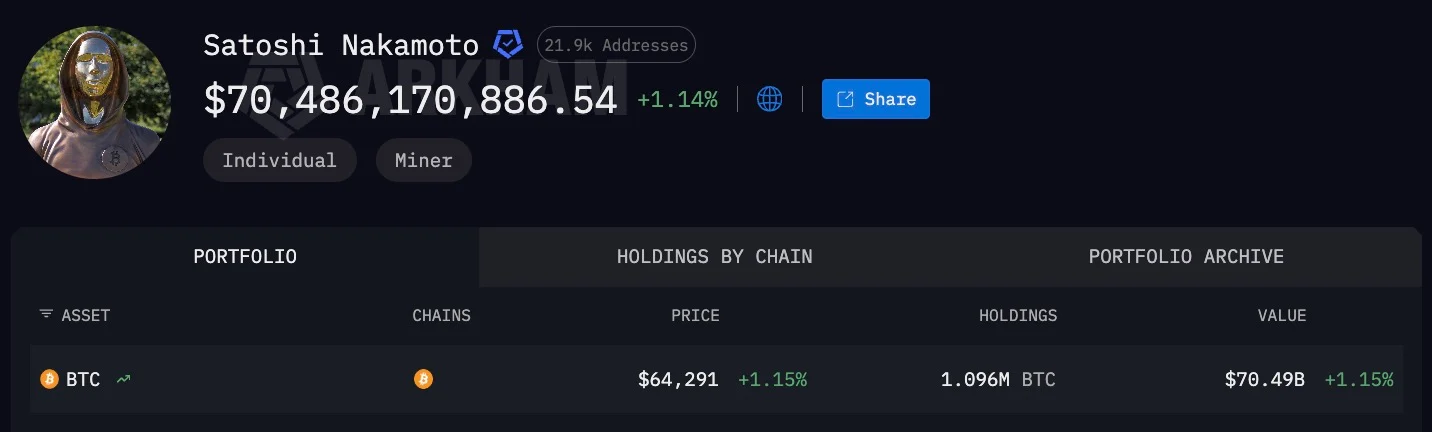
The report mentioned that these assets are dispersed across more than 22,000 early P2PK addresses, meaning Pay-to-Public-Key addresses. In other words, even if an attacker had theoretical cracking ability, accessing all the assets wouldn't be as simple as breaking into one wallet—they would have to individually attack a large number of independent addresses.
Brute Force Costs Far Exceed Reality
Researchers estimate that even if computing devices can generate 1 trillion combinations per second, it would take about 1.8 octodecillion years to have a 50% chance of finding a specific 24-word mnemonic phrase—far exceeding the universe’s age of around 13.8 billion years.
This is also why the technical community swiftly refutes such claims. The security of the Bitcoin network does not depend simply on “no one guessing,” but is instead built on an extremely large key space, making brute force attempts meaningless under real-world conditions.
If any movement occurs in these addresses that have been dormant for more than 15 years, the market may still respond rapidly. The reason isn’t that the private key has been guessed, but rather that these long-unutilized Bitcoin holdings themselves carry strong symbolic significance and could create liquidity shock expectations.
Discussion Extends to Self-Custody Security
This debate has also brought hardware wallet design back into the spotlight. Hashcash inventor Adam Back commented in the discussion that some hardware wallet manufacturers, in order to support a wide range of altcoins, build their devices on more general support schemes.
He believes that this approach may weaken specialized support for Bitcoin’s native security features. In contrast, devices designed to support only Bitcoin are simpler and make it easier to isolate the additional risks introduced by third-party technologies.
This standpoint doesn’t change the current Bitcoin wallet ecosystem, but it highlights the industry’s ongoing debate between “multi-asset compatibility” and “single-asset security prioritization.”
Disclaimer: The content of this article solely reflects the author's opinion and does not represent the platform in any capacity. This article is not intended to serve as a reference for making investment decisions.
You may also like
AutoCanada Profitability Seen Normalizing by 4Q -- Market Talk
Strategists warn: Gamma is extremely unstable! U.S. stocks with "ultra-low correlation" are facing the risk of violent shocks
This year, the low correlation in the U.S. stock market has been mainly driven by leading AI companies, but capital is shifting from semiconductor sectors towards lagging areas such as SaaS, narrowing the dispersion and weakening the foundation for low correlation. Bloomberg strategists warn that under abnormal Gamma volatility, a turn to negative could cause options dealers to reverse their hedging direction, amplifying market fluctuations. While the current index is less than 1% below its high, a 3% to 4% pullback could trigger a sharp Gamma reversal, putting the seemingly calm market at risk of dramatic volatility.
Web3: Bitcoin under pressure as miners, ETF, and strategy buying slow down
Bluesky Digital calls shareholder meeting on ChessGold acquisition


