
What Caused the Recent Bitcoin Price Surge in August 2026? Causes, Short Squeeze Mechanics, and Future Predictions
The global cryptocurrency market experienced a dramatic surge as the price of Bitcoin (BTC) jumped over 13% in a two-day rally. The digital asset broke through key resistance barriers to reach above $77,000. This sudden move snapped weeks of low volatility and lateral trading.
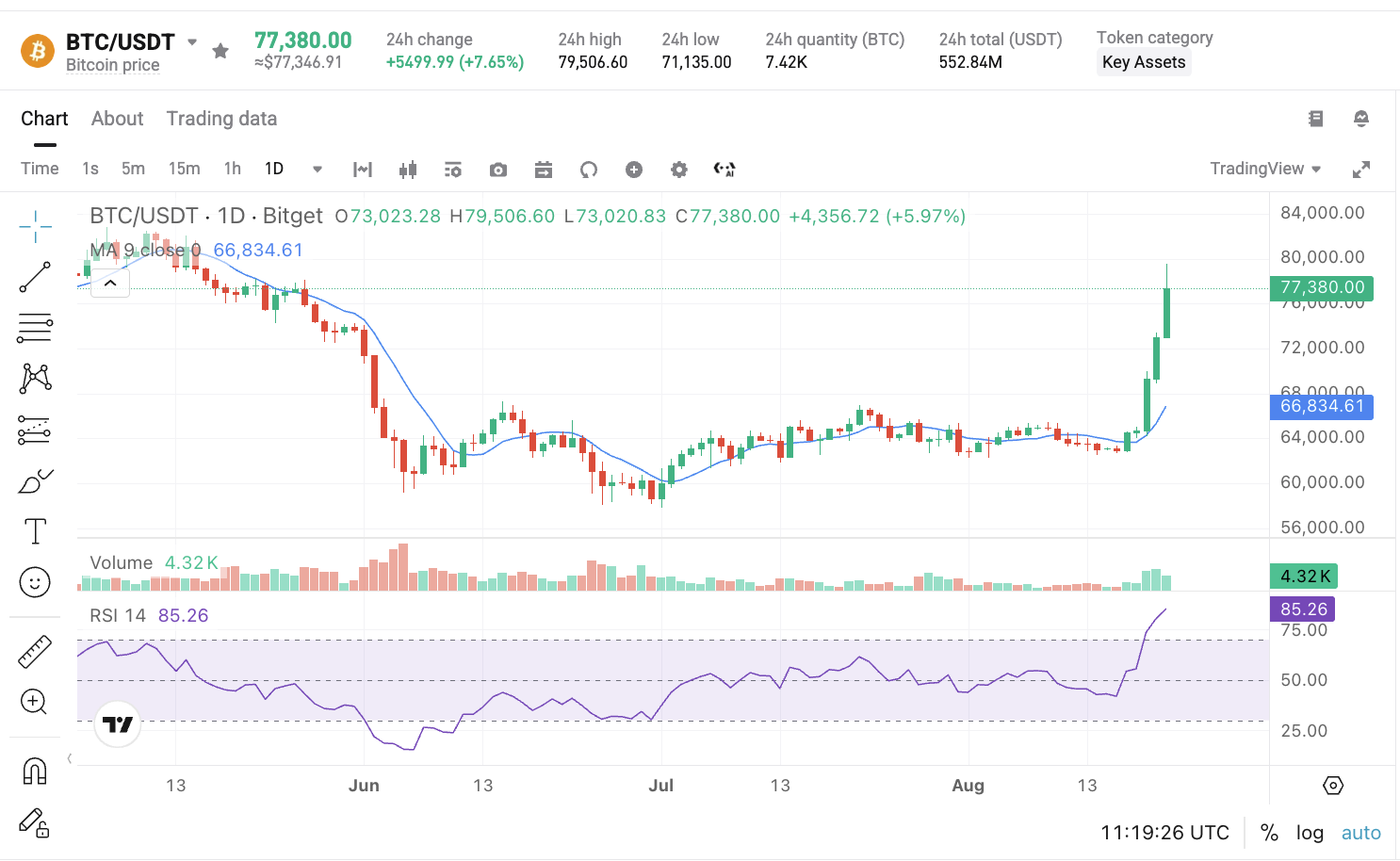
To understand why this happened, we must examine macroeconomic shifts in the traditional financial sector, structural trading mechanics on crypto exchanges, and what market analysts predict for the coming months.
The Root Cause: The $100,000 Dilemma and Yield Pressures
To understand why crypto markets suddenly sprang to life, one must look at the bond market. Capital had been locked out of high-risk assets because safe returns had reached levels not seen in almost two decades.
On August 18, the yield on the 30-year U.S. Treasury bond hit a 19-year peak of 5.33%. From an investor's perspective, if the U.S. government guarantees a 5.33% annual return risk-free for 30 years, there is little incentive to allocate capital into volatile assets like Bitcoin. The money simply stayed put.
Interest rates spiked because foreign buyers were stepping back:
- Japan’s Capital Return: Japan, historically the largest foreign holder of U.S. debt, saw its own 10-year bond yield rise to 2.9%—its highest level since 1996. Japanese investors began keeping their money at home where yields were finally attractive.
- China’s Reduced Holdings: China continued its multi-year trend of paring down U.S. debt holdings, leaving long-term U.S. bond auctions with weak demand and forcing yields higher to attract buyers.
With fewer foreign buyers for long-dated American debt, long-term borrowing costs soared. The SEC introduced a draft regulatory rule that same week, but the crypto market did not even react. Investors had no spare cash to take on risk while high yields locked up global capital.
The Catalyst: U.S. Bond Interventions and Dollar Debasement Concerns
The spark that lit the rally came directly from the traditional debt market. Reports indicated that the U.S. Department of the Treasury expanded buyback programs for long-term government bonds. The goal of this move was to stabilize surging yields and relieve pressure on the sovereign bond market.
The turning point arrived on August 19. U.S. Treasury Secretary Scott Bessent announced a major policy shift: the Treasury would double its liquidity support bond buyback operations, scaling up from $2 billion to at least $4 billion per operation for long-dated bonds (10-year to 30-year maturities).
When a sovereign government buys back its own long-term bonds, it steps in as its own creditor. The immediate impact was clear: 30-year bond yields pulled back to 5.19% on the news. Though investors had spent months waiting for the Federal Reserve to cut interest rates, the Treasury effectively executed a rate intervention on its own.
Also, when a central bank or government treasury steps in to purchase its own long-term bonds, it effectively suppresses borrowing costs. However, investors often view this intervention as a soft form of currency debasement—meaning the purchasing power of the fiat currency (in this case, the U.S. dollar) risks being diluted over time.
When traditional fiat currencies face inflationary pressure or government interventions, capital naturally seeks alternative stores of value. Gold saw an immediate jump of over 3%, while Bitcoin,often dubbed "digital gold" due to its hard-coded cap of 21 million coins, saw a massive influx of capital, surging 13% across the same two-day window.
Market Mechanics: Liquidations and Forced Buying
While macroeconomic news lit the fuse, the speed and scale of the price spike were heavily driven by market mechanics—specifically, short liquidations on derivative exchanges.
In financial markets, traders can take two primary positions:
- Long positions: Betting that the asset's price will rise.
- Short positions: Borrowing the asset to sell it, betting that the price will fall, so they can buy it back cheaper later.
Prior to the news, many leverage-heavy traders had opened short positions, expecting Bitcoin to break lower toward the $62,000 support level. When the sudden news caused prices to tick upward instead, these short sellers faced automatic forced closures (liquidations) by exchange risk systems.
To close a short position, the system must automatically execute a buy order. This triggered a feedback loop known as a "short squeeze":
- BTC price rises unexpectedly due to macro news.
- Short positions start incurring heavy losses.
- Automated liquidation engines force-buy Bitcoin to cover these short positions.
- Massive forced buying drives the price even higher, triggering the next batch of short liquidations.
Over the course of the two-day rally, more than $3.1 billion in short positions were liquidated across the digital asset space. This cascade of forced buying amplified what might have been a modest 3% bounce into a full-scale rally above $77,000.
Broader Market Impacts
The sudden movement in Bitcoin had widespread effects across the broader digital asset ecosystem and equity markets:
- Altcoin Momentum: Major alternative cryptocurrencies mirrored Bitcoin's momentum. Ethereum (ETH) climbed over 4.4% to trade near $2,390, lifting the overall global crypto market cap by roughly 6.6% to $2.6 trillion.
- Crypto Equity Divergence: Interestingly, institutional software and mining companies heavily exposed to crypto—such as MicroStrategy and Bitmine Immersion—initially lagged or faced pressure during Wall Street trading hours prior to the overnight breakout, highlighting a temporary divergence between spot asset prices and crypto-adjacent stock valuations.
- Derivatives Reset: The wipeout of $3.1 billion in short leverage reset open interest metrics across major exchanges. This effectively cleared out excess speculative leverage and re-established a cleaner foundation for spot-driven trading.
Market Predictions and Outlook
Despite the dramatic price spike, analysts remain divided on whether this move marks the start of a sustained bull run or merely a temporary liquidity bounce.
The Bullish Case
Proponents argue that bond market interventions mark the beginning of a broader global monetary easing cycle. If central banks continue to intervene to cap interest rates, hard assets like Bitcoin and gold are likely to continue attracting capital allocations from institutional funds seeking a hedge against fiat currency devaluation. Furthermore, clearing out heavily shorted leverage allows the spot market to build a base around higher support levels.
The Cautious Case
Conversely, macro-analysts urge caution. A significant portion of this rally was fueled by forced short liquidations rather than purely organic spot market buying. On-chain metrics show that trading volumes on major exchanges flattened slightly following the squeeze, suggesting that fresh institutional buy orders must arrive to keep prices elevated. If Bitcoin fails to consolidate above key support zones, the market could re-enter a consolidation phase as traders digest the economic outlook.
Conclusion
This recent rally proved that Bitcoin does not move in a vacuum of speculative hype. Instead, it sits at the intersection of global sovereign debt dynamics, treasury operations, and market leverage. When the U.S. government stepped in to absorb its own long-term bonds, it inadvertently lowered yields and activated a self-reinforcing liquidity loop that propelled capital directly into digital assets.
For investors navigating these macro-driven cycles, execution speed, institutional liquidity, and reliable trading infrastructure are vital. As the crypto ecosystem expands, trading on a secure, feature-rich platform like Bitget allows users to seamlessly capitalize on market momentum, access advanced derivative tools, and manage risk through every phase of the macro cycle.
Disclaimer: The opinions expressed in this article are for informational purposes only. This article does not constitute an endorsement of any of the products and services discussed or investment, financial, or trading advice. Qualified professionals should be consulted prior to making financial decisions.


- The Root Cause: The $100,000 Dilemma and Yield Pressures
- The Catalyst: U.S. Bond Interventions and Dollar Debasement Concerns
- Market Mechanics: Liquidations and Forced Buying
- Broader Market Impacts
- Market Predictions and Outlook
- Conclusion